



Select Sidearea

Populate the sidearea with useful widgets. It’s simple to add images, categories, latest post, social media icon links, tag clouds, and more.

[email protected]
+1234567890

Gavin de Becker

Emma Tekstra > Book Review  > Gavin de Becker
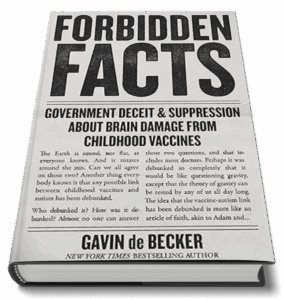
Forbidden Facts
– Gavin de Becker

While most people who read my newsletter regularly have at least a cursory interest in health, I interact with many people throughout the week who just go-with-the-flow on health topics. Science is not high on their list of priorities and while they may try to eat right and move more, they don’t spend a lot of time investigating the health topics that make headline news. If you’re one of these people (or even if you’re not) Gavin de Becker’s new book – Forbidden Facts – is for you.

Why a criminologist who is an expert on security and protection decided to write a book about health issues you’ll have to judge for yourself, but his sardonic wit and objective presentation make Forbidden Facts a rollicking read.

I wasn’t initially interested in the book when I saw it advertised, as much of the content is not new to me, but I was handed a free copy at a conference and started flipping through. The fast pace and sharp humor got me quickly hooked.

It starts with a bit of a history lesson regarding Agent Orange (used in the jungles of Vietnam) and how the government needed to debunk the idea that this toxic chemical wasn’t causing illness in returning veterans. Enter the infamous Institute of Medicine (IOM), that prestigious-sounding entity which is actually a private organization mostly funded by Big Pharma. De Becker demonstrates the wordsmithing used to message the public about the inconvenient data as if he were writing the script for a sit-com. (IOM has since been renamed the equally prestigious-sounding National Academy of Medicine).

Covering a variety of topics like cancer from baby powder, Gulf War syndrome, silicone breast implants, burn pits and SIDS, all similarly debunked by IOM (and later quietly “un-debunked”), de Becker provides QR codes that link to all the information cited and walks the reader through a wonderland of evidence and rabbit trails, all with his unique edge of humor.

With the groundwork laid, de Becker then introduces the topic of autism and the most high-profile debunking of all: that autism is not caused by vaccines. His unique style first takes a step back to understand the term autism and appreciate that part of the mystery lies in the terminology itself.

Autism incorporates a vast range of health problems including neurological and neurodevelopmental disorders. Many people may be surprised to see the list of known side-effects from the vaccine-makers’ own package inserts including seizures, encephalitis, transverse myelitis, Guillain-Barre syndrome, ataxia, Bell’s palsy, stroke, meningitis, multiple sclerosis, neuropathy . . . a sample of the list in the book which is provided by individual vaccine, all of which involve brain inflammation and potential brain damage, ie. neurological and neurodevelopmental complications.

To give you a sense of de Becker’s humor about such a serious topic, chapter 8 is called “Seizures, Convulsions, Neurologic Disorders & Other Perfectly Normal Pastimes for Babies”. This is all about the normalization of sick kids and the wordsmithing involved to convince parents there’s nothing to see here.


While this is not a book digging into the science, there is some high-level science included like the toxicity of mercury in any of its forms and its use in vaccines (even though the CDC claims mercury has been removed from vaccines since 2001, oh except the flu vaccine). But don’t worry, you can skip the science and just enjoy the ride through history as the reality presented is far more surreal than fiction.

How about that oft-cited statistic that childhood vaccines have saved 150-million lives. Have you ever wondered where that statistic came from or how it could have possibly been calculated? De Becker gives us a bit of insight.

Towards the end de Becker opens up the transcript of the IOM committee’s deliberations on the autism-vaccine link. While it sounds deathly boring to listen to a bunch of doctors talking about science, it is in fact the darkly funniest part of the book. Mainly because there is actually no science discussed at all, only word games that you wouldn’t believe without the links to the actual transcripts.

Useful appendices provide additional links to published science, newspaper articles on the “unexplained” sudden deaths of a sample of 259 healthy young people (ages 5 to 25) in 2021 and 2022 and a cheat sheet of questions to test your doctor’s knowledge on these issues next time they recommend a pharmaceutical product as your best course of action.

Again, it’s not a book about the science (read mine if that’s your preference!) but it will open your eyes about government deceit and what goes on behind the closed doors of power. From my perspective, whatever angle will awaken your curiosity and critical thinking skills, so much the better. de Becker’s unique approach certainly captures the attention of the skeptical and the uninterested.

Emma Tekstra
No Comments

Post a Comment

Comment
Name
Email
Website