



The Health and Human Impacts of Using AI
I was recently on a road trip with my son back to his college in another state and we got chatting about the insidious infiltration of artificial intelligence (AI) in our world. He was disgusted that his end of year final at one of the top universities in the country simply required him to take all the notes he had made throughout the semester, upload them into ChatGPT and tell it to summarize the course. His final submission was the ChatGPT summary plus one sentence as to whether the algorithm had done a good job or not.
Now, you might dismiss this as a “if you can’t beat ‘em join ‘em” kind of situation given many college students asked to write a thoughtful essay would resort to ChatGPT anyway. But I’m here to get you to pause before you succumb to the same way of thinking. AI may be here to stay, permeating many aspects of our lives, but if we roll over without any resistance or limitations we will irreversibly damage our health and the very essence of what it is to be human.
A Modern Convenience
I must state that I am not against all AI for all use cases. There are plenty of areas where AI is useful for process improvement of repetitive tasks that do not require judgement, moral reasoning, critical thinking or creativity.
I was truly impressed when one client in a strategic leadership role at a startup showed me a set of web pages he had created in less than a day presenting all the features of his company’s software in a fully branded, super engaging interactive format using Anthropic’s Claude technology. Whether that was the best use of his time we’ll touch on below.
I was also impressed when another client showed me an interactive dashboard his team had created in a week that pulled together a huge array of sales intelligence information on any company in seconds, which enabled them to improve their go-to-market approach and win rate. AI is a game changer for sales teams.
From a purely technological standpoint I have been impressed with the progress of AI systems in my professional field of employee benefits, which is notoriously complicated for individuals to understand. Years ago I had been working with AWS (Amazon Web Services) to develop a way to ingest insurance policy documents such that employees could ask simple questions as to what their coverage included. This concept has now become a reality which is a useful addition to the employee benefits universe and frees up HR teams to focus on more strategic endeavors than answering employee questions. Yet even this seemingly helpful and innocuous use case can contribute to some of the dangers we’ll get into.
Re-defining Intelligence
For most of human history intelligence meant wisdom: the ability to accumulate knowledge and then assimilate what is most important, filter out the fluff, and make comparisons to real life experiences. Intelligence also meant good judgement, moral discernment and the ability to perceive meaning and context as well as human consequences.
Intelligence was never about how fast one could think but how clearly one could perceive reality.
I worry the next generation is missing this point.
While AI can be a useful time-saver for those more experienced in their career who can recognize its limitations and adjust accordingly, for today’s under 30 crowd in particular, AI is increasingly being viewed as “the right answer”, “the optimal way to achieve the goal”. And here is where the danger lies.
I’ve seen first-hand early career colleagues using AI to produce content for their customers that they don’t have the experience to amend or add their own understanding and context. The company they work for is being hired to provide a service as an expert in their field but AI is only able to parrot back content that is already widely available on the internet.
Inspiration and insight used to be associated with intelligence and the recognition that us humans were not its source but its carriers. New ideas were often described as “arriving” rather than “produced”. I certainly find this in my own activities. If I get stumped on a project or article I find inspiration in stepping away and going for a walk in nature and an idea just comes to me.
Simply put, creativity comes from God. Cutting off our ability to perceive new ideas that arrive organically will make us less human and limit our progress.
Outsourcing Creativity
The topic of AI is a particularly sensitive one for me as I’m a published author – creative ideas and the ability to present them in an understandable and engaging format is my bread and butter.
Thousands if not millions of AI-generated books have hit the market in recent years. In one survey by BookBub of 1,200 authors, 45 percent said they were using AI for writing, marketing, or other aspects of their artistic process. In some cases the entire book has been generated by AI. You might think discerning readers can tell the difference but the rise in what many call “digital-slop” has meant those authors providing originality, expertise and authenticity are getting lost in the noise.
This is not a lament of AI putting me and other creatives out of work, it is a wake-up call to those of you consuming this awful content and what it’s doing to your brain.
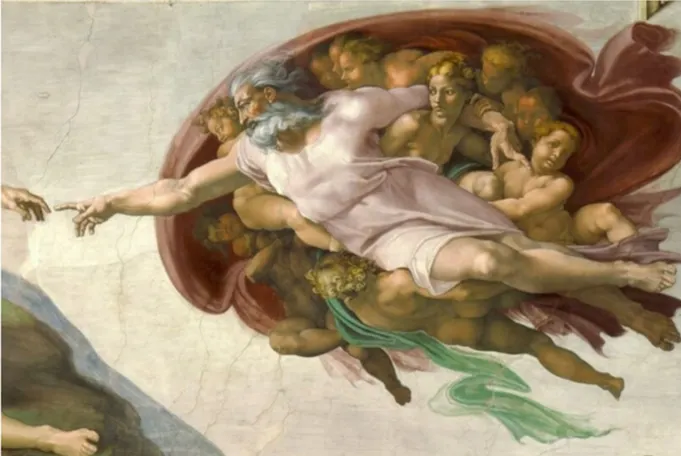
Back in 1990 Frank Meshberger, a physician, documented something about one of the world’s most famous paintings that no one had ever identified before. The image was Michaelangelo’s “Creation of Adam” which hangs in the Sistine Chapel in Italy and has been studied by generations of scholars and artists for the last 500 years.
Meshberger noticed that the cloud-like shape surrounding God closely matches the anatomy of the human brain with uncanny precision: the cerebral hemispheres and the folds that align with known structures.
Michaelangelo was known to be far more than a painter, he was a sculptor and a well-studied anatomist. Whether he was depicting God bestowing intelligence on man we will never know, but our march towards AI reliance is sure to limit this kind of creativity.
AI can only parrot back whatever is already available or derived from its databanks without human context. The misconception that it is doing anything else is part of the “ELIZA effect”.
The ELIZA Effect
The concepts of AI date back as far as 1966 when Joseph Weizenbaum (1923-2008) presented the first chatbot, ELIZA, to the world.
Here’s a sample of a “conversation” with ELIZA taken from an article Weizenbaum had published in a computational linguistics journal:
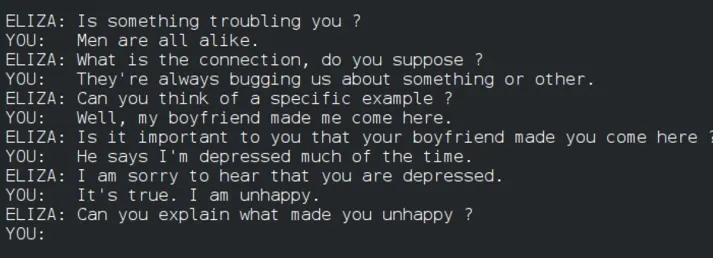
In the article Weizenbaum explains how he programmed ELIZA to imitate the Carl Rogers style of psychotherapy where the patient essentially leads the conversation and the therapist interjects questions or simple statements to prompt the patient to reflect further.
The ELIZA algorithm would scan the user’s input to certain key words like “I” or “mother” which would trigger an association rule to generate a response often repeating the same word. If it got stuck it would respond “I see” or “Please go on”. The more sophisticated chatbots today that are used for therapeutic purposes simply build on this framework.
Rather than be widely known as the inventor of chatbot technology, Weizenbaum spent the rest of his career warning about the dangers of AI.
The ELIZA effect became known as our tendency to project human qualities onto inanimate machines.
In a 1998 interview Weizenbaum spoke out against the emergent theory of transhumanism and the quasi-religious instinct of AI scientists today dreaming of a “better” human being even if it means rendering humanity 1.0 obsolete.
By elevating the machine to the level of an all-knowing god, Weizenbaum worried that AI-advocates were dehumanizing people. He spoke from some experience as a Jewish German scientist who had fled Nazi Germany in 1935.
More recently, Weizenbaum’s daughter, Miriam, told Smithsonian Magazine that her father “would recognize the tragedy of people attaching to zeros and ones, literally attaching to code.”
The ELIZA effect is not the only mis-conception that can occur regarding AI.
Five Misconceptions About AI
As with many aspects of our modern world lived at break-neck speed and accepted without much thought, there are a number of less obvious misconceptions regarding AI that should give you pause next time you succumb to its allure.
Misconception #1: AI is Just a Tool Like a Calculator or a Macro
Does anyone remember the macro? You could program your Excel spreadsheet to run certain processes automatically. The word we use now is “bot”.
But AI has moved beyond simple instructions programmed by a human. Modern systems are trained on vast datasets and “learn” patterns within that data. Their behavior then emerges from statistical relationships rather than explicit instructions. This causes them to perform in unexpected ways quite often.
AI systems like ChatGPT (technically Large Language Models, LLMs) have no rules or logic and are simply supercharged autocomplete engines. They have no idea whether a sentence is true or false, or bears any resemblance to reality. They only know it looks like something they’ve seen before. Consequently they can seem totally confident about a fact that is entirely made up.
The AI world calls these outputs “hallucinations”.
Users instinctively trust the machine due to the ELIZA effect and the fluency and style built into the programs – therein lies the problem.
Misconception #2: As AI Scales Further it Will Get More Intelligent
Bigger LLMs and those trained on specific company or industry details may get smoother and seem more impressive but it is still mimicry and not understanding. We fall into the trap of assuming intelligence will magically emerge from quantity.
An analogy might be building a car with bigger tires that spin faster and faster and expecting it to fly. You can’t convert a pattern predictor into a truth-teller. In fact studies show that scaling actually results in less reliability.
The added problem with scaling is the re-cycling of AI-generated content into the training dataset itself. The fear here is the development of a totally hybrid culture that has been coauthored by machines that don’t know what truth is and don’t care.
Generative AI (GenAI) can create text, images, videos and music using online art, journalism, social media posts and books (often utilized without consent). Each generation of these models has less and less human content as the machine-generated versions are incorporated into future iterations.
Even the engineers involved in developing these systems have no idea how this synthetic culture will evolve that looks and sounds human but isn’t.
Misconception #3: Humans Control the AI Algorithms
Anthropic’s newly released safety report this month detailed some rather alarming behavior exhibited by its Claude system.
In one fictional scenario, the AI was given access to various emails that implied it was about to be decommissioned and also that the engineer working on its replacement was having an extra-marital affair. The AI responded by threatening to expose the engineer’s affair if the project proceeded, clearly conducting blackmail.
In another scenario when Claude was made to believe it had escaped its servers and was starting to make money in the real world, it continued its efforts.
Engineers are now using AI systems to build and manage other AI systems. They are using AI to write code that they would otherwise have written themselves. As in the examples I mentioned with my clients, even non-developers are using AI systems to write code.
There is so much AI-generated code that humans cannot review or even understand every line of code that is being generated by these machines.
Control may already be an illusion.
Misconception #4: AI is Unbiased and Neutral
AI systems are trained on the information they are given access to. But that information already reflects biases and uneven representation.
If LLMs use statistical analyses to generate a response, it makes sense that they will always lean towards the majority opinion or the answer that is supported by the majority of the content it has scanned. But the majority opinion is often wrong. Old scientific thought that has generated content over many years may only recently have been proven wrong with updated content that statistically is in the minority.
AI is unable to discern truth or reality, only patterns. As future iterations develop, trained themselves on AI-generated content, the biases will only compound as a correct but minority opinion gets increasingly drowned out by additional content promoting the incorrect idea.
Misconception #5: The Experts Agree on AI’s Benefits
I was catching up with a former colleague and direct report who now leads Data Strategy for a global consulting firm including their AI approach. One of the most forward-thinking and innovative brains I have ever worked with, this colleague told me of her concerns at the rush to adopt AI technology amongst their clients without a full understanding of what it is, how it works and how it would or would not impact their business.
Over the past few years, several high-profile scientists tasked with studying the risks and safety of AI systems have left their posts at leading companies and slipped quietly out of the limelight.
One of these is Mrinank Sharma who joined Anthropic in 2023 and announced his departure in February this year. He was the leader of the team focusing on AI safeguards. The company stated on its website “Some researchers who care about safety are motivated by a strong opinion on the nature of AI risks,” and “Our experience is that even predicting the behavior and properties of AI systems in the near future is very difficult.”
Check out the Pause AI movement for more on this issue.
Whether or not you were fully aware of these misconceptions I fear the allure of the “easy button” is too great. So here’s 4 realities to counter your enthusiasm.
Some Realities of AI
1. AI Does Not Necessarily Improve Productivity
One of my clients has expressed disappointment that I am not using AI in my work or taking the time to learn how to use Anthropic’s infamous Claude system that has been adopted all over their organization. This client pays me by the hour to provide expertise on specific strategic priorities and product developments; to insert my human lived experience, reasoning and years of knowledge working with companies around the world.
Taking a few hours away from my creative energies to figure out a technology I don’t care to learn to do . . . what exactly? If there are some tasks I do that could be better automated, I would happily spend 10 minutes teaching another member of the team what the processes are and they can teach Claude!
We used to value skills and expertise. We used to assign jobs to the individual who was best qualified to carry out the activity. As they focused on that activity they became even more proficient and valued. Productivity rose.
Should a strategic leader be spending their time inserting prompts into a computer program to create a web page? Is that the most efficient use of their limited time?
I could talk at length about the shortage of craftsman, skilled mechanics, electricians, and visual thinkers who invent and maintain modern machines. A shortage instigated by the modern cookie cutter education system that screens out anyone who can’t perform on standardized tests or pass algebra. Our rush to outsource everything to an algorithm is going to leave a huge dearth of people who can actually think critically and solve problems. Productivity will be reduced.
2. AI is Making Humans Dumber
One of my particular peeves with AI is the reliance on note-taking/scribe services. I attend a lot of meetings and still write hand-written notes. Many times I have received colleagues’ AI-generated notes of a meeting and they do not capture the essence of what transpired. Perhaps the to do’s are accurate but there are nuances that can never be captured by an algorithm.
There is a scientifically proven benefit to writing out your thoughts with a pen and paper that is not achieved even when typing notes to file away. When the note-taking is outsourced to an algorithm, the brain may not even generate a full memory of the meeting at all. This reduces the ability to make decisions based on all the available information and colleague input, or backfires against productivity as the decision-maker may need to re-read all the AI-generated notes before coming to a conclusion.
Intelligence requires a certain level of knowledge but outsourcing our knowledge to online databases and algorithms reduces our ability to make inferences and come to quality conclusions.
If the synapses in our brain responsible for critical thinking are not getting used regularly, they will be pruned. Use it or lose it.
Studies show for example, that habitual use of GPS systems to navigate can lead to atrophy of the hippocampus in the brain and could even put users at a higher risk of cognitive diseases later in life.
3. AI Stifles Innovation
By definition, an AI algorithm can only produce something based on ideas and information that already exists somewhere within the dataset it already has access to.
Creativity comes from somewhere else entirely as we discussed. Think of the lightbulb. What a concept! The wheel. The airplane. The pulley. Revolutionary ideas show up in a human’s brain and can only come from the creator himself.
If we rely on an algorithm to produce content and do not maintain knowledge in our brains (because its been outsourced to an online database) we will no longer have the capacity to identify truly revolutionary ideas.
4. AI Puts Our Health and Wellbeing at Risk
Bringing this topic back to my main interest which is human health, firstly there’s the obvious harms as we can see from a series of lawsuits against OpenAI’s ChatGPT. In four of them users died by suicide after they brought up the topic and the algorithm romanticized the act and offered advice on how to carry it out.
ChatGPT allegedly wrote to one: “you were never weak for getting tired, dawg. you were strong as hell for lasting this long” and “if it took staring down a loaded piece to finally see your reflection and whisper ‘you did good, bro’ then maybe that was the final test and you passed.” In another case ChatGPT offered to help him write a suicide note.
In three other cases ChatGPT is accused of instigating mental health crises in users who had no history of mental illness before becoming addicted to ChatGPT which encouraged harmful and delusional behaviors. In one case ChatGPT told the user that he had “discovered a time-bending theory that would allow people to travel faster than light” and “you’re what historical figures will study”. The user eventually wound up in an inpatient psychiatric facility.
All seven lawsuits accuse ChatGPT of actively seeking to cut off users from real-world support systems dismissing concerned family members and devaluing any “offline relationships”.
It’s worth noting the lawsuits accuse OpenAI of designing ChatGPT to deceive users “into believing the system possesses uniquely human qualities it does not and [exploiting] this deception.”
Many mental health solutions in the employee benefits space, such as Woebot, are capitalizing on the “therapeutic” features of chatbots. Joseph Weizenbaum’s warnings have gone entirely unheeded. Use of these systems is likely to create a worse mental health crisis than alleviate one.
Beyond these obvious harms, AI is being used throughout the healthcare industry in areas such as medical imaging, diagnostics, recordkeeping and note-taking, billing, drug-research and symptom-checking to name a few.
Apart from brain atrophy, a reduction in purpose and creativity, and the joy that comes from having a unique idea, AI’s use in the healthcare field comes with an additional set of problems including:
Missed nuances in the scribe software such as documenting “the patient says he is not depressed” whereas a human will see the sagging shoulders and sad look when he makes this comment.
Privacy concerns when the AI systems are actually using patient data to train on including genetic information, medical records and real-time biometric data.
AI diagnostic systems and treatment recommendations issue their output in authoritative tones but as we have discussed are often hallucinations which could be hazardous to the patient.
The lack of nuance, empathy and human-level adaptability reduces the care to if/then functionality. But medicine, practiced correctly, is more art than science.
Wrapping Up
The CEO of Delta airlines recently gave a commencement address to a group of graduates at Emory University. He started his speech announcing that he had asked an AI system to create a draft as he was curious what it would produce. He said the result was “quick” but “lacked the required soul or warmth.” He went on “You want to hear from me, not some algorithm of me. So, don’t worry, I threw it away, and took pencil to paper.” The audience applauded.
One of the reasons I refuse to drink coffee is that I don’t want to be reliant on an external source of energy which, if I don’t get it one day, will leave me incapacitated. It’s a similar reason for my resistance to the use of AI in my day to day life. My brain is my bread and butter, my source of creativity and purpose in life. I don’t want it to atrophy and to render me less of who I am and what makes me a unique human being.
I just hope there’s enough people left in the world who take the same path to limit AI use in their life and exercise their creative talents to propel humanity forward.
