




Why Sunscreen is Wrecking Your Health – 5 Tips
I am undoubtedly a sun worshipper! If the sun is out I feel a need to be in it. I moved to California from the UK in my 20s principally for the sunshine and ocean.
You may be surprised to learn that I rarely use sunscreen. The toxic cocktail of chemicals that has been sold to us to avoid cancer and wrinkles actually causes both, along with a whole host of other health problems.
Even those marketed as healthier “mineral based” formulas have insidious health consequences. The higher the SPF the worse it is.
Our amazing bodies, and the skin that protects it, have inbuilt mechanisms to avoid sunburn and utilize the sun’s rays for good. It just needs a steady supply of antioxidants from healthy foods, supplemented where necessary, and an avoidance of skin-damaging toxins like industrial vegetable and seed oils.
The Sun is Our Lifeforce
The message that too much sun is bad for us has gotten seriously out of hand in recent decades. While a severe sunburn does cause skin damage, regular exposure to the sun is critical for good health.
Our skin is designed to react to sunlight. When the sun hits our exposed skin a magical orchestra of activity kicks in that feeds our cells and organs. For a start, our skin synthesizes vitamin D which acts as a hormone in our body and supports hundreds of processes.
Studies show the proliferation of adverse health effects associated with low sun exposure including diabetes, cardiovascular disease, osteoporosis, autoimmune conditions, and even cancer. One study estimated insufficient sun exposure as “responsible for 340,000 deaths in the United States and 480,000 deaths in Europe per year, and an increased incidence of breast cancer, colorectal cancer, hypertension, cardiovascular disease, metabolic syndrome, multiple sclerosis, Alzheimer’s disease, autism, asthma, type 1 diabetes and myopia”. It goes on to advise that “oral vitamin D supplementation has not been convincingly shown to prevent the above conditions”.
Even skin cancers have been shown to be inhibited by sunlight.
 Getting out in the sun improves our circadian rhythm which regulates many of our physiological processes. Too little sun can cause sleep disorders which are detrimental to our health and overall wellbeing. I always recommend morning sun exposure to anyone who’s having trouble sleeping well.
Depression can be caused by too little sun on our skin. The sun triggers the production of beta-endorphins which are neurotransmitters in the brain that transmit electrical signals to our nervous system. They reduce our perception of pain and make us feel good.
Sunshine also enhances Nitric Oxide (NO) production which is vital to blood circulation and managing blood pressure. NO is a vasodilator which expands blood vessels to increase blood flow, reducing clotting and the formation of plaques.
Built-in Protection
Part of the amazing activity going on when sunlight hits your bare skin naturally protects the body from damaging forms of radiation. Pigment cells called melanocytes start making melanin which travels to the surface creating a microscopic shield. Scientists have shown how these melanin packets absorb ultraviolet radiation and dissipate it as heat, while also scattering some light and helping to protect us from DNA damage.
As sun exposure continues, the outer skin adds another layer of protection through a microscopic thickening of the skin cells.
We refer to these changes as a suntan and while once seen as a sign of health and vitality, the culture has increasingly depicted a tan as a sign of skin damage but this couldn’t be further from the truth. A meta-analysis of 57 studies reported while “intermittent sun exposure and sunburn history were shown to play considerable roles as risk factors for melanoma, a high occupational sun exposure seemed to be inversely associated to melanoma”.
It other words, a sunburn is risky but a sunburn is usually due to intermittent sun exposure rather than allowing the skin to develop its own protection with a suntan.
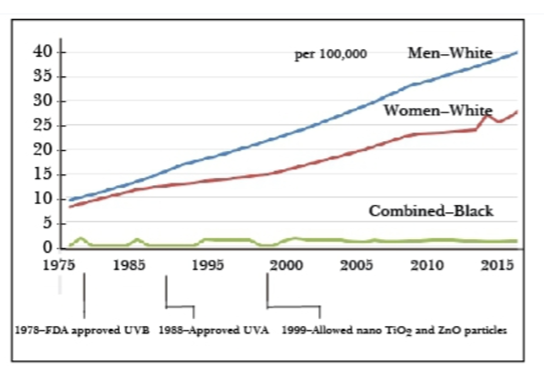
When chemicals are applied to the skin, it stops the natural physiological processes taking place which are protective to the body and instead introduces toxins that are damaging the organs. This is why both melanoma and non-melanoma (squamous and basal cell cancers) have actually skyrocketed since sunscreens were introduced 50 years ago.
The data shows melanoma rates have increased 200% between 1973 and 2011 with over 5 million people now treated for skin cancer annually in the US. The increase is even higher at 253% for young adults and adolescents.
The Science Behind Those Sunscreen Chemicals
Solar radiation from the sun consists of various wavelengths, with only about 4% ultraviolet (UV) radiation. The first sunscreens introduced in 1978 only blocked UVB rays which include the wavelengths that cause sunburn. However, it was soon understood that it’s actually UVA rays that penetrate deeper and can cause melanoma. So now we have what are called broad spectrum sunscreens which block both UVA and UVB.
The problem is, the remaining radiation includes 47% near infrared radiation (NIR) and then visible light (49%). It is the NIR that penetrates most deeply into our skin structures where they cause damage leading to cancers. There is nothing we can put on our skin to stop these deeply penetrating wavelengths.
So we have stopped the sunburn which makes us stay longer in the sun creating more damage, and we have stopped our skin’s ability to make its own complete sun protection through its interaction with UV rays.
Looking now at the ingredients of these sunscreens, there are essentially two types:
Chemical filters (like oxybenzone (BP3), octocrylene, homosalate, and avobenzone) which absorb the UV rays.
Physical (mineral) filters (like zinc oxide, titanium dioxide and aluminum oxide) which scatter and reflect the UV rays and have been marketed as “safer”.
Endocrine Disrupters
The chemical UV filters have been shown to be endocrine disruptors – that is they disrupt normal hormonal regulation.
Structurally they mimic the shape of natural hormones so they are capable of binding to the body’s hormone receptors and blocking the action of estrogen, testosterone, and thyroid hormones for example. This interference can disrupt our immune system, our behaviour, our reproductive system and our nervous system.
The FDA admits the absorption of these chemicals is higher than once thought following publication of research in the Journal of the American Medical Association in 2019 that found using the recommended amount of four different sunscreens for just one day increased levels of these chemicals in the bloodstream. They were also found in amniotic fluid, urine and human breast milk raising concerns about their effects on fetal development.
While much attention has been paid to BPA in plastics due its estrogenic influences, there has been no recognition of the need to ban these estrogenic chemicals from sunscreens though the harm to our bodies is the same. In fact due to the permeability of our skin, and the amount of product we apply, sometimes multiple times a day, the risk is likely higher.
Some researchers go so far as to include the liberal use of sunscreens on children and while pregnant in the rise in gender dysphoria and related conditions.
Nanosized Minerals
As people became educated on endocrine disruptors, the industry found a way to market mineral sunscreens as “kid safe”. These usually include zinc oxide and/or titanium dioxide.
In their original “bulk” form these substances are a white paste often added to paint, lacquers, paper, toothpaste and even some processed foods. They were generally recognized as safe and no further testing was done before their approval for use in sunscreens. However, to make them easier to apply and even reduce their opaque white look, manufacturers reduced the particle size down to nano-size which has significantly changed their chemical properties and made them toxic to health.
At this tiny size, they can penetrate the skin and other tissues easily, and are more reactive with biological tissues, causing damage to cells and to the DNA within cells.
The size of a nanometer(nm) is one-billionth of a meter. We are talking about something 1/5000th of a human hair. A nano-particle is less than 100nm. Some savvy manufacturers claim they are using micro-particles instead. But a micro-particle is simply above 100nm. At these tiny diameters there is little safety in 150nm versus 50nm when it comes to the ability to enter our cells and affect our health as has been shown by research.
Furthermore, the bulk product has since been shown to be harmful and the tremendous reduction in particle size only exacerbates the danger enabling the particles to travel throughout the blood stream, the lymphatic system and cross the blood-brain barrier.
One of the biggest dangers is the epigenetic changes they seem to induce in gene expression, particularly of the MTHFR gene. MTHFR is a master gene that impacts your ability to methylate, an important process that affects your brain chemistry, inflammation, cell repair, your immune response, your ability to detoxify, your stress response and how other genes are expressed.
The connection to epigenetic changes may explain the wide range of health conditions found to be caused by the chemicals in sunscreen. Drs Elizabeth and Marcus Plourdes, both PhDs, have written extensively about the topic of radiation (from EMFs) and the dangers of sunscreen to human health as well as the environment. Their books Sunscreen: Biohazard first written in 2012 and a follow up in 2019 summarizes over 200 scientific papers on the toxicity of sunscreen and connection to a wide range of health issues including:
Fertility and fetal development
Hormone and thyroid disruption
Oxidation and premature skin aging
Inflammation
Heart, liver and immune function
Cancers (breast, prostate, and skin)
Microbiome disruption and leaky gut
Mitochondrial disfunction
Neurological conditions
Mental health
To sum up then, the 4 ways you are being misled on sunscreen:
Sunscreen stops our skin forming vitamin D and other healthful compounds
It stops our skin forming its own natural protection from the full range of harmful wavelengths in sunlight.
It stops us getting God’s built in warning sign, a sunburn, so we stay too long in the sun where the near infrared rays create lasting damage
The chemicals in the sunscreen are doing ongoing damage to our organs, our hormones, and our neurotransmitters.
5 Tips to Avoid Sunburn Naturally
Make it a habit to get in the sun daily. There is no universal guideline to how much you need depending on your skin type or where in the world you are but the Dminder app can help you optimize. As little as 10 minutes a day will help your skin to adapt. If heading out on vacation expose more skin for gradually longer periods.
In particular omega-3 fatty acids found in salmon, mackerel, herring and sardines as well as nuts and seeds. Plus plenty of brightly colored vegetables like leafy greens, carrots, peppers, tomatoes, berries, as well as garlic and many herbs and spices.
Trans fats as well as polyunsaturated fats like corn, soy, safflower, sunflower and canola (also known as industrial seed and vegetable oils) are highly damaging to the skin. They are stored in the body for months and break down into harmful compounds when exposed to UV rays promoting sunburn and thinner skin. Refined sugars, artificial colorings, preservatives and emulsifiers cause increased inflammation and disrupt gut microbiota which can instigate skin damage.
Astaxanthin is a potent antioxidant with a myriad of benefits in the body including protection against radiation. One of its unique features is to protect both water- and fat-soluble parts of the cell. It helps protect against UV sun damage, increases skin elasticity and reduces fine wrinkles. Take 12mg a day, at least during summer months and in the weeks leading up to outdoor vacations. Niacinamide (50mg daily) has also been shown to reduce UV damage and support DNA repair.
If you’ll be out in the sun all day it would be beneficial to wear a hat and cover up once your skin has been exposed for a little while to get its vitamin D fix. This is needed for those who haven’t built up a tolerance yet or had a chance to rid their bodies from the harmful additives in #3. It will also depend on the time of day as the sun’s ray are strongest usually in the middle of the day, and the time of year.
I might be accused of having olive skin and an easier time in the sun, but I assure you my private parts that don’t see the sun are lilly white! I just make sure I’m in the sun as often as possible with as much skin exposed as the temperature and decency allows. I eat healthily, drink a lot of water and never wear cosmetics which is likely my real secret to youthful looking skin in my mid 50s.
If I’m on a beach or sitting by the pool for an extended period of time I’ll put on a single application of the safest sunscreen I can find but it is a rare occurrence (and after doing the research for this article may never happen again!). I won’t give you a list of “safer” formulations as manufacturers are notoriously changing their ingredients and processes and I don’t want to imply any are truly safe. But I will say some of the worst are the most popular brands like Coppertone, Banana Boat and even Neutrogena.
 The Risks to Our Kids: Quick side-bar on the younger crowd. Please refrain from slathering copious amounts of chemicals on their delicate skin which has a much higher surface ratio to body size than adults. Follow the 5 tips above to protect the littleuns. Also be mindful of the toxic soup most public pools are these days where chlorine has been shown to aggravate the damage done by the mentioned chemicals. And run run away from any family using those spray sunscreens which are truly evil as we inhale the chemicals straight into our bodies and they are carried far on the wind.
